
|
|
|

|
 Follow us
|
|
|
There is no great mystery in HOW TO BUY A DIAMOND.
In the 10 minutes it takes to read the following information, you can possess as much, if not more diamond knowledge than your average diamond sales person.
|
|
|
|
|
Here are the factors that make up Cost
CARAT
CARAT means weight (1 carat = 1/5 of a gram). The diamond weight is a very important factor to its cost.
The term "carat " originated from the seeds of the carob tree. These carob seeds are extremely uniform in eight and this made them the ideal weight unit for the ancient gem traders. This weight (one carob seed) as later standardized to be 1 carat, or 1/5th of a gram, hence a five carat diamond equals 1 gram and 155.51 carats equal one ounce.
The one carat weight is then broken down into 100 equal parts called "points"; 75 points equal 3/4 of a carat, 50 points equal 1/2 of a carat, etc. The significance of the weight is like the other quality grades. Rarity, now by virtue of the diamonds size and weight. Out of 250 tons of diamond ore only a single one carat diamond of gem quality may be found. The value of weight a 100 point (1 full carat) diamond of VS-1 clarity and G body color is generally worth more than an identical VS-1, G color diamond with a weight of .99 carats (less than a full carat). A one point difference in a diamond can make a difference in value.
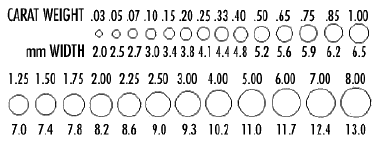
It is important to understand that the weight of a diamond and its physical size are two different things. Even if the only difference between the two diamonds is .01 carat. Take for example two (2) VS-1, G quality grade 1.00 carat diamonds to show the vast difference in value that the cut will make. One of these diamonds could have the Ideal 6.5 millimeter diameter size one would expect to see in for a 1.00 carat diamond. In the other example, the second 1.00 carat diamond may have only a 5.5 millimeter diameter. Because of this one millimeter diameter size difference, and yet the same carat weight, the smaller diameter diamond would be worth somewhere around 20% less than the Ideal cut diamond of the same weight and quality grade.
These value differences will vary depending upon the size and quality grade of the diamond you may be interested in. This leads us to the fourth quality grade which is the diamonds cut. Every Diamond belongs in a weight grouping class for a range of weight where the prices per carat for each Color and Clarity group combination are listed. The main reason for this is obviously due to rarity in nature, but current market conditions at any specific time plays a very important role. Some sizes and shapes fall in and out of demand due to what is fashionable or considered affordable in society. Because of this, some size groupings for
a given shape may have a higher demand and price per carat than one expects, given its rarity in nature.
So to simplify, a diamond in the 1 carat class (1.00-1.49) usually costs more per carat than a diamond less than 1 carat in weight (0.90-0.99). A diamond that is 1 full carat in size, has a higher demand, which causes it to be priced higher. The result is rough stones that could possibly have been cut into beautiful smaller stones are usually cut into not so beautiful 1 full carat stones to get into the higher price range. There are other factors and trade-offs this is just a simplified answer to the reason the cost per carat goes up as the size goes up.

COLOR
Each grade can have a 10-15% variance in it's price range for a given size group, down to M, and then it changes again depending on the Hue & Color for the Fancy Colored Diamonds.
Diamonds occur naturally in all spectral colors, from red to blue, however the most commonly occurring colors are yellow and brown. The amount of color a diamond possesses is graded by an alphabetical scale D through Z. They began at D in case a whiter diamond was later found. Color & Cut are the two factors that influence a diamond's beauty the most.
Color should reflect one's tastes and budget. i.e.: You may be able to go with a higher color grade and lower clarity grade to suit your taste and stay within budget.
Diamonds of a colorless grade in the D-F range are much more valuable than diamonds in the L-P range because of the rarity of these colorless diamonds. This is not to say that the diamonds in the lower color range are not pretty, they can have just as much brilliancy and sparkle but with a stronger color tone. The effects of color to the cost of a diamond can be dramatic. Two diamonds of the same weight, clarity , size and shape can have a cost difference of over
100% for the difference between an F body color to a J body color . Color can only be graded accurately if the diamond is un-mounted or "loose" and
it is highly recommended that the diamond be independently certified for its color as well as the other following quality grades. The color of your
diamond will be simply a matter of personal taste and if you don't like the color - just plan to spend more money!
Another color factor to consider is Fluorescence, properly called photo-luminescence. Fluorescence is caused by a trace amount of the element boron found in the diamond. It is activated by UV light. Fluorescence in a diamond is usually described on a certificate (GIA, EGL, etc.) as None, Faint, Medium, Medium blue, Strong, Strong blue and Intense Blue. Other colors of fluorescence do occur, yellow and white for example (try to avoid them), but it is the blue we are most commonly involved with. In the old days people used to come looking for the perfect "blue-white" diamond. The blue referred to the fluorescence and the white to the diamonds body color. Some people think diamonds exhibiting fluorescence is out of fashion, but Gems and Gemology (put out by GIA) GIA states that typically fluorescence is a plus in a diamond. Most people feel that fluorescence is beautiful and rare in a diamond, so in a few years fluorescent diamonds may be back in fashion and will demand a premium. If you want a diamond that exhibits fluorescence be sure you examine it under all light conditions, especially direct sunlight and a jewelers black light, since some fluorescent diamonds will actually become hazy in the sunlight and others will glow in a black light environment (including a dance floor) if the fluorescence is Intense (and sometimes Strong). With Strong or Intense fluorescence I advise you to fully examine the stone, each diamond will exhibit its own traits, and in many cases these traits will have a positive effect, often causing the diamond to have a little "extra life" in the sunlight. If you are dealing with a diamond of D, E, or F color, fluorescence is usually a negative since it won't make it look whiter, and may make it look a bit hazy in sunlight. On the other hand, if you are dealing with a diamond in G, H, I, J, or K color, fluorescence is normally a plus, and will whiten the diamond one or more grades, thereby increasing the diamonds beauty and desirability.
So to sum up, examine any diamond with fluorescence under all light forms and make up YOUR mind for YOURSELF, as to whether it is a plus or minus.
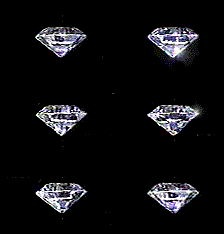
| COLOR | GIA* | CIBJO* |
| COLORLESS | D | EXCEPTIONAL WHITE+ |
| E | EXCEPTIONAL WHITE | |
| F | RARE WHITE+ | |
| NEAR COLORLESS | G | RARE WHITE |
| H | WHITE | |
| I | VERY SLIGHTLY TINTED WHITE | |
| J | SLIGHTLY TINTED WHITE | |
| FAINT YELLOW
to FAINT BROWN |
K | TINTED WHITE |
| L | ||
| M | TINTED COLOR 1 | |
| VERY LIGHT YELLOW
to VERY LIGHT BROWN |
N | TINTED COLOR 2 |
| O | ||
| P | ||
| Q | ||
| R | ||
| LIGHT YELLOW
to LIGHT BROWN |
S | TINTED COLOR 3 |
| T | ||
| U | ||
| V | ||
| W | ||
| X | ||
| Y | ||
| Z | ||
| CHAMPAGNE
COGNAC GREENISH BROWNISH YELLOW |
C+ | FANCY COLOR |
| LIGHT FANCY | ||
| CANARY YELLOW
GREEN BLUE PURPLE PINK RED |
FANCY | |
| FANCY INTENSE | ||
| VIVID | ||
| * GIA = Gemological Institute of America.
* CIBJO = Confederation Internationale de la Bijouterie, Joaillsrie, Ortevrerie, des diamants, perles et pierres precieuses. |
||
| IF to VVS grades | VS to SI grades | I-1 to I-3 grades | |
| D E F colors | strong -10%
moderate -5% weak -0% |
strong -5% to -10%
moderate 0% to -5% weak -0% |
-0% |
| G H I J colors | strong -5% to -10%
moderate -0% to -5% weak -0% |
strong -0% to -5%
moderate -0% weak -0% |
-0% |
| K L M colors | strong -0 to -5%
moderate -0% weak -0% |
strong -0%
moderate -0% weak -0% |
-0% |
CLARITY
| FL | FLAWLESS
describes diamonds in which a gemologist under favorable lighting conditions, cannot see any inclusions at ten power magnification |
| IF | INTERNALLY FLAWLESS
describes diamonds which have no internal characteristics observable under the the same conditions as (FL), but which have minor surface blemishes that do not penetrate the stone. |
| VVS1 |
VERY, VERY SLIGHTLY INCLUDED
describes diamonds that have very, very small inclusions which are difficult for a gemologist to see at 10x magnification. |
| VVS2 | |
| VS1 | VERY SLIGHTLY INCLUDED
describes stones with very small inclusions which can be difficult to observe with 10x magnification. Inclusions are barely visible to the unaided eye, except on some larger stones or large Emerald Cuts. |
| VS2 | |
| SI1 | SLIGHTLY INCLUDED
describes stones with small inclusions which are usually obvious when viewed with 10x magnification. Inclusions are difficult to see with the unaided eye, except on larger stones or occasionally with Emerald Cuts. |
| SI2 | |
| SI3 | |
| I1 | IMPERFECT or PIQUE
describes stones with medium to large inclusions (Piques) which are usually obvious to a gemologist with the unaided eye. An I1 may have inclusions barely visible or located to the side while an I2 will have numerous inclusions that may be centerally located. |
| I2 | |
| I3 |
CUT
|
|
|
|
|

|

|

|
|
When purchasing a 1.0 carat or larger Diamond, we strongly recommend a
Gemological Laboratory Certificate and/or Appraisal prior to purchase.
We use fully accredited Gemological Laboratories able to perform
Diamond Identification, Diamond Grading, and Appraisals of Gems and Jewelry.
The following links are to reputable Gem Laboratories and Appraisers (in Alphabetical order)
AGS
| EGL
| EGL ASIA
| GIA
| GUILD
| IGI
| SSEF
| Components | AGS 000 | Ideal Proportions | Near Ideal Proportions |
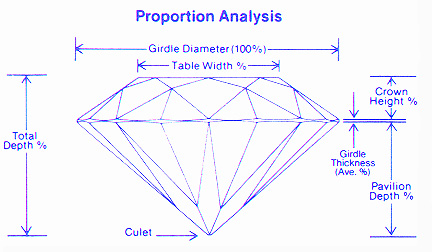
| Total Depth | 61.6 - 62.7% | 60.1 - 62.8% | 57.0 - 65.0% |
| Table Diameter | 54.0 - 57.0% | 53.0 - 58.0% | 51.5 - 60.0% |
| Girdle Thickness | thin to medium | very thin to medium | very thin to thick |
| Culet Size | none | none to medium | none to sl. thick |
| Crown Angle | 34.5 degrees | 33 - 35 degrees | 30 - 35 degrees |
| Crown Height | variable | 16.2% | 11.0 - 16.2% |
| Pavilion Angle | 40.75 degrees | ||
| Pavilion Depth | 43% | 43.1% | 41.5 - 45.5% |
| Symmetry | excellent | excellent to very good | excellent to good |
| Finish | excellent | excellent to very good | excellent to good |
| Components | Ideal Proportions | Near Ideal Proportions |
| Total Depth | 58.0 - 75.0% | 56.0 - 82.0% |
| Table Diameter | 57.0 - 78.0% | 54.0 - 85.0% |
| Girdle Thickness | thin to thick | thin to thick |
| Culet Size | N/A | N/A |
| Crown Angles | 30.0 - 37.5degrees | 29.0 - 38.0degrees |
| Crown Height | N/A | N/A |
| Pavilion Depth | N/A | N/A |
| Symmetry | excellent to very good | excellent to good |
| Finish | excellent to very good | excellent to good |
Depth proportions are measured from the diamond's narrowest measurement
The Ideal shape for Princess cut is @1.0 x 1.0, +/- 10%
ie: 6mm x 6mm to 6mm x 6.60mm
The Ideal shape for Emerald and Radiant cuts are 1.30 x 1, up to 1.40 x 1
ie: 9mm x 7mm, or, 7mm x 5mm, etc.
Many wonder what the difference is between the Princess cut and the Radiant cut... well, they are actually the same cut. The difference is in the shape of the stone. As you can see from the notations above, Princess cut is "1.0 x 1.0, +/- 10%" so they would be very square in shape. A Princess cut becomes a Radiant cut when it starts getting more rectangular. In other words, if the stone measures 7.0mm x 7.7mm (within 10% of being square) it's still a Princess cut, but if it were 7.0mm x 7.8mm, and anything beyond that, it should rightfully be called a Radiant cut. A well proportioned Radiant cut or Emerald cut should be between 1.0 x 1.3, up to 1.0 x 1.4 (example: 7.0mm x 9.1, up to 7.0mm x 9.8mm). Typically the Princess cut also has square corners, rather than the cut corners normally seen on the Radiant and the Emerald cut.
| Components | Ideal Proportions | Near Ideal Proportions |
| Total Depth | 57.0 - 65.0% | 53.0 - 69.0% |
| Table Diameter | 52.0 - 64.0% | 51.0 - 66.5% |
| Girdle Thickness | thin to sl.thick | thin to thick |
| Culet Size | N/A | N/A |
| Crown Angles | 33.0 - 34.0 degrees | 31.0 - 36.0 degrees |
| Crown Height | N/A | N/A |
| Pavilion Depth | N/A | N/A |
| Symmetry | excellent to very good | excellent to good |
| Finish | excellent to very good | excellent to good |
Depth proportions are measured from the diamond's narrowest measurement
The overall shape considered as "Ideal" for Marquise diamonds is 2 to 1
i.e: 5mm wide and 10mm long
The Ideal shape for Oval cut is 1.30 x 1, up to 1.40 x 1
i.e: 9mm x 7mm, 7mm x 5mm, etc.
The
Ideal shape for Pear shape cut is 1.30 x 1, up to 1.40 x 1
i.e: 9mm x 7mm, 7mm x5mm, etc.
The "Ideal" shape for a Heart shape cut is 1 to 1
i.e: 6mm x 6mm
SYMMETRY
Symmetry refers to how well the facets of a diamond align and intersect. This includes extra factes, badly shaped facets, off center culets and tables, and/or wavy girdles.
A diamond with fair to poor symmetry may misdirect light that travels into the diamond, sending it off at slightly wrong angles, and thereby reducing the diamond's brilliance. Often, a diamond cutter will purposefully allow a minor reduction in symmetry as a way of preventing a defect present in the rough stone from being retained as part of the finished diamond.
GIA graded diamonds display a symmetry grade using the following scale:
| Excellent | No symmetry defects visible at 10x magnification. |
| Very Good | Any defects are extremely difficult to see at 10x magnification. |
| Good | Any defects are difficult to see at 10x magnification. |
| Fair | Defects are noticeable at 10x magnification, and may be visible to the naked eye. |
| Poor | Defects are visible to the naked eye. |
A symmetry grade of Excellent to Good should not be used as a primary factor in choosing a diamond, since each of these grades is possible in diamonds of exceptional appearance.
Symmetry is really more important for diamonds in the VVS2 clarity range and higher, since the very subtle defects produced by Fair or Poor symmetry (which can look like they are small inclusions) may compromise the diamond's otherwise flawless appearance.
Even though symmetry does have a minor impact on appearance, it has a significant impact on price. ie. A diamond with Excellent Symmetry and Polish can carry a price of around 10%-15% higher than one having Good Symmetry and Polish. This is an added cost that is more of a perceived value of an "excellent" grade, rather than the actual effect on the diamond's appearance.
Typically diamonds with Poor symmetry have defects that are visible to the naked eye, and they should be avoided in all cases.
Our recommendation is that a diamond should not be chosen or rejected based solely on symmetry. The overall Cut grade already incorporates symmetry, so symmetry should not be used as the primary determinant when choosing a diamond. it is only when you are comparing two diamonds of equal Color, Clarity, and Cut that Symmetry is used as a determining factor when making a selection.
POLISH
Polish refers to the degree of smoothness of each facet of a diamond as measured by a gemologist. When a diamond is cut and polished, microscopic surface defects may be created by the polishing wheel as it drags tiny dislodged crystals across the diamond's surface. Depending on the severity, these defects may disrupt light patterns as the light rays enter and exit the diamond.
Each Lumera Diamond displays the polish grade as determined by the GIA, using the following scale:
GIA graded diamonds display a polish (or finish) grade using the following scale:
| Excellent | No polish defects visible at 10x magnification. |
| Very Good | Any defects are extremely difficult to see at 10x magnification. |
| Good | Any defects are difficult to see at 10x magnification. |
| Fair | Defects are noticeable at 10x magnification, and may be visible to the naked eye. |
| Poor | Defects are visible to the naked eye. |
Diamonds having a polish grade of Excellent to Good will not have polishing defects visible to the naked eye, and should have no impact on the diamond's overall appearance.
A polish grade of Fair is acceptable for diamonds with clarity grades of I1 or lower, mainly because they already possess so many internal inclusions that are visible to the naked eye that the polish has far less relevance.
Diamonds that are 0.75 carats and smaller, can have a polish grade of Fair or better since the polish will not adversely impact the appearance of the diamond to an untrained observer.
A polish grade of Poor should be avoided, regardless of the size or clarity of the diamond.
CE and HTHP
Clarity Enhanced (CE) Diamonds are totally natural Diamonds that have been treated with a New Clarity Enhancement Process. This new revolutionary process optically eliminates "feathers" (inclusions), which are naturally occurring imperfections found in most diamonds.
High Pressure High Temperature (HPHT) Diamonds are also totally natural Diamonds that have been treated with a complex process that involves heating the stone while it's under pressure until the desired alteration of color and/or clarity is evident. This treatment is only performed on certain diamonds.
The results are more visually stunning diamonds that you can purchase for significantly less than a similar-looking, non-enhanced diamonds, where only you and your jeweler will ever really know that you own a CE or HPHT Enhanced Diamond.
CE and HPHT Diamonds are both natural diamonds from deep in the heart of the earth which have been technologically enhanced to become as brilliant, clear and beautiful as modern science can make it.
When light travels from one medium to another, it either changes its course or reflects in a different direction. When light attempts to pass through a non-enhanced diamond that may have typical feather inclusions, the light hits the feather and reflects off in any number of directions. The more feathers, the more the diamond appears to be non-transparent. With a CE or HPHT diamond, the light passes THROUGH the natural inclusions, because the material used for the enhancement has the same optical characteristics as the diamond. The beam of light "thinks" it's still traveling through the same material (diamond) and continues its original course. The amount of material used to fill the feather is so minute that the Gemological Institute of America (GIA) has reported that the clarity enhancement process ADDS NO WEIGHT to a diamond.
This treatment method is permanent and normally does not create special care requirements.
Clarity Enhanced (CE) as well as High Pressure High Temperature (HPHT) Diamonds are normally GUARANTEED FOR LIFE by the manufacturer.
The CE clarity enhancement is permanent and is not visible to the naked eye, except the only things likely to compromise the integrity of your CE diamond's enhancement are the flame of a torch or boiling acids and bases. In the unlikely event your CE diamond should lose its enhancement, usually the manufacturer will restore the enhancement of your diamond, free of charge.
The HPHT clarity enhancement is totally permanent, even with the flame of a torch or boiling acids and bases.
You can usually expect to pay 15% to 25% less than what you'd pay for a natural Diamond for the same color and clarity.
|
|
 |
||
|
|
||
email
 Contact Contact
|
||
| 1-805-735-7103
Hours : Mon-Fri 10am-5pm Pacific Time 24 hours Voice Mail |
||
